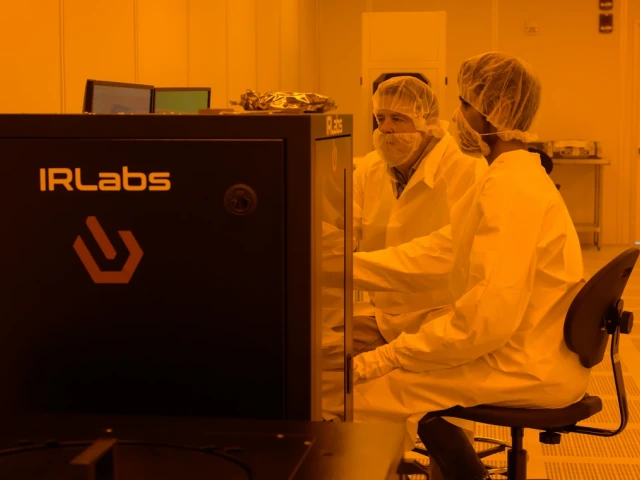
IRLabs donates high-tech microscope to U of A Center for Semiconductor Manufacturing
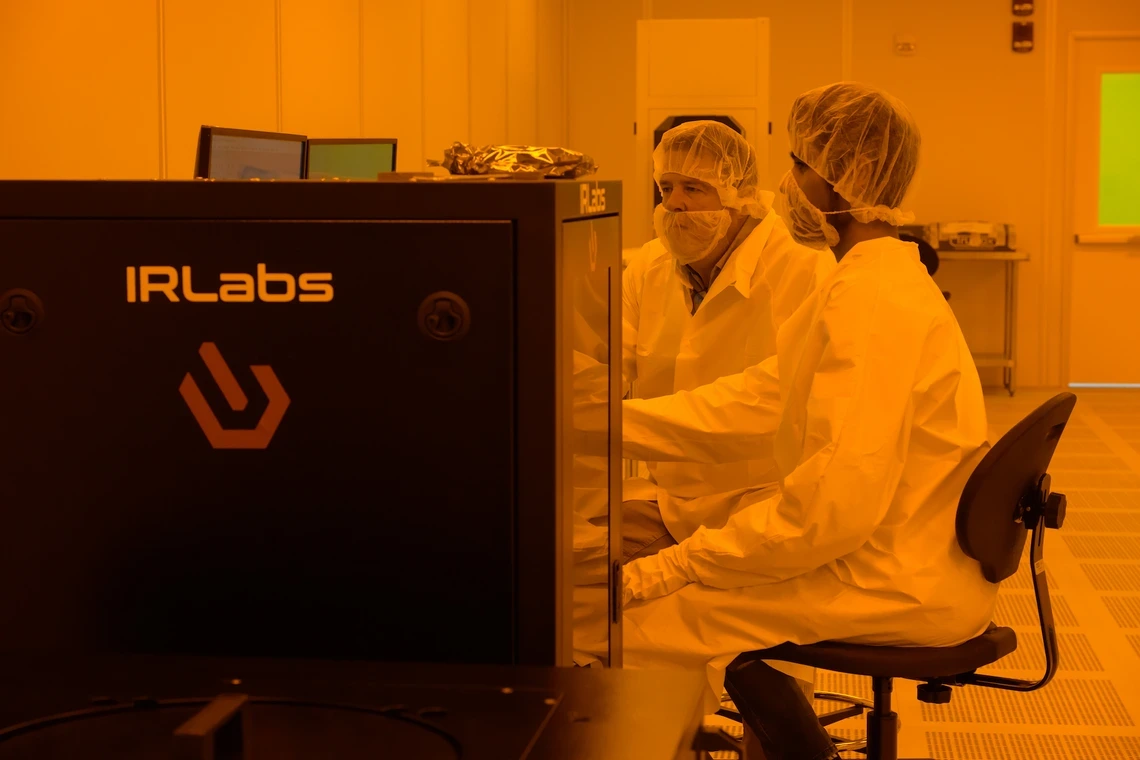
The infrared microscope is widely used to identify defects and conduct failure analysis of semiconductor chips, which are the foundation of today's advanced technology.
Kris Hanning/Office of Research and Partnerships
A million-dollar infrared microscope capable of detecting defects invisible to the human eye is now operational in the University of Arizona's Nanofabrication Core Facility, thanks to a transformational gift from IRLabs.
The Nanofabrication Core Facility is a key component of the Center for Semiconductor Manufacturing in the Office of Research and Partnerships. IRLabs, a Tucson-based optics and cryogenics company, donated the instrument to support workforce training and research in semiconductor manufacturing.
"We are deeply grateful to Manny Teran and IRLabs for this generous gift, which serves as a powerful catalyst for our mission to advance semiconductor innovation in Arizona," said Tomás Díaz de la Rubia, senior vice president for research and partnerships. "At the University of Arizona, we believe the most transformative research occurs at the intersection of world-class expertise and state-of-the-art infrastructure. Strategic partnerships like this allow us to bridge the gap between academic discovery and workforce readiness, reinforcing our role as a cornerstone of the state's thriving semiconductor ecosystem."
Semiconductor chips are the foundation of today's advanced technology. Their manufacturing process requires extreme precision, as even the smallest error can render a chip unusable.
The infrared microscope is widely used to identify defects and conduct failure analysis of semiconductor chips. Infrared emissions can be detected at each step of the manufacturing process, providing vital clues about the integrity of the final product.

Manny Teran, IRLabs CEO and U of A mechanical engineering alumnus, with Krishna Muralidharan, director of the U of A Center for Semiconductor Manufacturing and professor of materials science and engineering.
Kris Hanning/Office of Research and Partnerships
"If you have a major issue with these chips, that's tens of millions of dollars lost," said Manny Teran, IRLabs CEO and U of A mechanical engineering alumnus who graduated in 1999. "We can use failure analysis techniques to understand where things will break."
IRLabs founder Frank Low, a U of A scientist who died in 2009, invented infrared telescopes to observe distant galaxies and star formation. He adapted the technology in the mid-1990s for use with Intel's computer chips. Intel and NVIDIA use the infrared emission microscope, known as IREM, during production to ensure quality.
Installing an IREM on campus has been a priority for Teran since he became CEO of IRLabs in 2022.
"By donating this equipment to the University of Arizona, we will have students who are familiar with it when they graduate and can join the industry quickly," he said. "Many ideas don't come to fruition because the right equipment isn't available. I want students and faculty to have access to this and imagine what's possible."
The microscope is a crucial component of the center's cleanroom, where researchers, students and industry partners develop computer chips, optical devices and quantum computing systems.
"This greatly enhances the cleanroom's ability to lead in failure analysis of semiconductor chips," said Krishna Muralidharan, director of the Center for Semiconductor Manufacturing and professor of materials science and engineering. "It is useful for researchers and students on campus and will be available to others in the semiconductor ecosystem."
The facility, located in the Electrical and Computer Engineering Building, was recently renovated with support from a $35.5 million award from the Arizona Commerce Authority. It meets International Organization for Standardization 5 classification, meaning it is a highly controlled environment with stringent requirements for air cleanliness, which is crucial to protect sensitive chips from dust and particles during manufacturing.
"Access to facilities like the Center for Semiconductor Manufacturing is critical to success of researchers and students alike," said John-Paul Roczniak, president and CEO of the University of Arizona Foundation. "This philanthropic partnership is especially meaningful because of Manny and the company’s history with the U of A. They are giving back, while also investing in the workforce for a future-shaping industry. I’m grateful for their vision and generosity."
The donation comes as Arizona has secured more than $210 billion in semiconductor-related investments since 2020, creating nearly 25,000 jobs.